
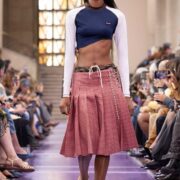
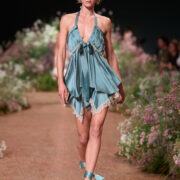



This season, DI PETSA didn’t present a collection—it delivered a radical psychological intervention.
Under the concept of “The Archaeology of Self,” DI PETSA’s runway was transformed into an introspective excavation site. Models moved as if someone unearthed – shattered, beautiful, and profoundly vulnerable. The collection demanded that the audience confront the messy reality that identity is not a polished statue, but a shattered, reconstructible ruin. The set design itself was key, immediately immersing the audience in the brand’s world of water and ruin, turning the front row into privileged witnesses of a mythic quest.
The philosophy underpinning the collection that “our memories, myths, and forgotten selves are buried like fragments of marble” was realised through a brilliant rupture of the brand’s own established codes. This is a collection translates inner struggle into exterior form through visceral excavation. More than just a show, it felt like a love letter to the fractured, enduring power of the feminine spirit, making every look an ode to a modern, complex Aphrodite.

The Unfiltered Body as Artifact
The exposure was intentional: you weren’t witnessing an unnecessarily sexualised form of fabric but rather an intimate confession of self, rendered in silk and sheer jersey. The collection presented Every exposed part of the body as an artifact, precious, true, and worthy of veneration, not shame.
The commitment to this raw truth extended to the designer herself. Unlike the detachment often seen at high fashion shows, Dimitra Petsa personally shared the beauty and makeup looks, placing herself into the collection. This move reinforced the idea that the brand is not merely selling clothes; it is presenting the designer’s own truth
Wet Looks Ruptured and Reconstructed

The use of silk and jersey ribbons were loosely draped and layered across the body. Dissolving the strict lines of the garment and allowing the natural form beneath to exist in translucent, unfiltered honesty. The clothes look like they are in the process of being found. Transforming restriction into revelation and defying the industry’s obsession with clean, finished polish.
The commitment to rupture extended into the beauty. Each model’s hair appearing covered in mud and stone, as if they had literally just climbed out of the earth. This application of dirt becoming a staple of the beauty. It further immerses the audience into this new world. Blurring the lines between the delicate clothes and the rugged reality of excavation.
Inclusivity as Ideological Subversion
This isn’t tokenism; this is inclusivity as a core design principle. According to Vogue Business size inclusivity report, this show featured a remarkable 45.5% mid-size looks and 13.6% plus-size looks. By embracing bodies across the spectrum, the designer makes the political statement that all bodies are worthy of excavation and divine transformation. More than that, they are worthy of being within the fashion sphere. It provides a direct counterpoint to the narrow perfection demanded by traditional luxury houses.

Artifacts, Alchemy, and the Mythic Self
The Finality of Unearthing
All images courtesy of DI PETSA and Purple PR
Don’t miss out on more cutting-edge fashion news. Leave a comment below telling us your favourite look. Follow us on Instagram: @StyleCartel and @StyleCartelMedia.
