






In the global fashion landscape, the most significant shift isn’t happening on a mood board in Paris or a digital mock-up in New York. Instead, the industrial heart of Northern Portugal engineers this change. While traditional manufacturing giants navigate a period of contraction, the Portuguese footwear sector executes a masterclass in industrial rebranding. It now stands as the high-tech, high-precision backbone of the modern luxury market.

The Resilience of High-Value Exporting
The current success of the Portuguese footwear industry defies global trends. In 2025, while major competitors like China and Turkey saw production declines of 11% and 13% respectively, Portugal maintained a positive trajectory. Specifically, by exporting 68 million pairs of shoes worth €1.718 billion, the sector outperformed its direct European rivals, growing by 0.8% while Italy and Spain saw contractions.
Furthermore, this resilience stems from a deliberate pivot toward segments where technical excellence (yes you read that correctly, not price) drives the decision. By concentrating 82% of its exports in high-quality leather footwear, the industry has evolved from an “affordable manufacturer” to a “luxury essential.” Prestigious houses such as Loewe, Lanvin, and Rolex validate this shift, as they rely on this Portuguese cluster to translate their heritage into physical products.
The Factory Floor: Where the Future is Built
The true “secret” of the industry lives on the factory floor, where the line between artisanal craft and robotics has vanished. At the Portuguese Footwear Technological Center (CTCP), the focus is on the “qualification” of the product: ensuring that every pair of shoes meets rigorous international standards.
Similarly, visiting these facilities uncovers a cluster that operates with unparalleled versatility and a relentless work ethic. At Bolflex, a leader in footwear components for over 30 years , the operation runs “24 hours a day” to keep pace with global demand. The company embodies the “everything in-house” philosophy that defines the region. “We do everything in-house, from the idea to the final product,” their team explains. To achieve this, they produce their own moulds and rubber formulations on-site. Moreover, to ensure precision before a single sole is cast, they deploy 3D printing to send mock-ups to clients, allowing them to adjust height or width before sculpting the final aluminium mould.
In the same vein, this technical mastery powers the high-performance sector at AMF Safety Shoes. Here, the manufacturing process presents a choreographed display of chemical engineering and mechanical pressure. Notably, to create their specialised soles, technicians mix and inject liquid chemicals at high temperatures, reaching approximately 80°C. “We inject the outsole… it gives better slippery resistance, additional abrasion resistance, resistance to oils, everything,” the AMF team explains. Ultimately, they fuse safety with comfort, injecting a soft midsole so “it’s comfortable for people to walk around”. With finishing lines churning out up to 1,100 pairs of shoes per shift, AMF proves that industrial-scale production can still maintain a meticulous eye for detail, from “moulding the heel part” to “encapsulating the toe cap” for ultimate protection.
Engineering a Sustainable Defense
In the light of global shifts, Portugal is also using sustainability as a definitive competitive advantage. Whereby “green” production is the new luxury status symbol. Through the BioShoes4All project: a €70 million initiative, the industry is overhauling its production cycle. At Bolflex, this isn’t just a mission statement; it’s a mechanical process called “devulcanisation.” This patented, chemical-free process allows the factory to recycle full shoes (leather, insoles, and all) into entirely new pairs of soles. As a result, the Bolflex team notes, it’s a massive step forward for the circular economy: “I can produce a rubber sole with a lot of recycle, and you don’t even notice”. To manage this, they even founded a dedicated recycling unit, RubberLink. This allows them to reincorporate industrial waste back into their production line.
The Knowledge Roadmap: Sowing the Seeds of Talent
The evolution of the sector is being reinforced by a unique community-led strategy. APICCAPS, the national association founded in 1975, has launched the “Knowledge Roadmap” (Roteiro do Conhecimento), a school-based initiative for students aged six to twenty. By doing so, this program brings the reality of modern manufacturing into the classroom. It is actively encouraging a new generation to see the industry as a space for creative problem-solving.
Central to this is the “Magical Box” concept. As project representatives describe: “We help them to use sustainable materials to develop new products and a kind of really original shoe. And then we have an open day… where we invite families and the kids to come here to have the award ceremony.” By challenging students to build original shoes from found materials, the industry is ensuring its future talent pool understands both design and environmental responsibility from day one.

The “Work-to-Lifestyle” Shift
Meanwhile, perhaps the most significant cultural shift within the factories is the move toward “aesthetic performance.” At AMF, the goal is to dismantle the idea of the “ugly” safety shoe. Their brand, To Work For, draws inspiration from lifestyle giants like Carhartt, using earthy tones and premium fabrics. It’s their way of ensuring workers don’t feel the need to change after their shift. “If you don’t do something more aesthetic… you can meet your family and you don’t need to take out your clothes,” they note, emphasising that the modern worker is looking for inspiration beyond the traditional “bright yellow” safety gear.
Equally important, academic rigour backs this forward-thinking mindset. Specifically, AMF partners with the University of Minho and the University of Porto to develop empirical solutions, such as movement sensors embedded in shoe soles that measure employee fatigue and prevent injuries.
Lisboa Fashion Week: The Performance of Agility
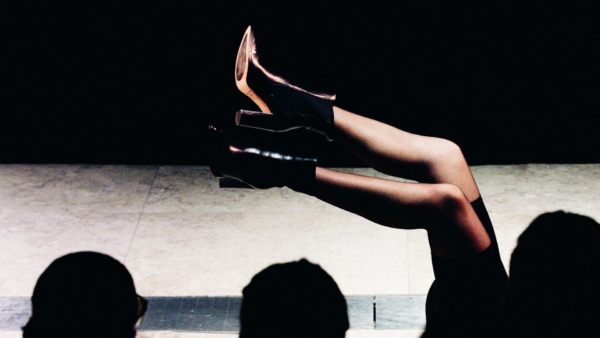
The final link in the chain from factory to runway was most visibly demonstrated at Lisboa Fashion Week (ModaLisboa). The “Portuguese Shoes” presentation by APICCAPS functioned as a live manifesto of the sector’s agility. In a testament to the industry’s ability to perform under pressure, the dancers involved in the showcase had only started practicing their routine two weeks prior to the event.
Even more strikingly, the performers only put on the featured footwear for the first time on the day of the show. This “on-the-fly” execution served as a metaphor for the industry’s current state: a sector capable of taking bold risks and delivering functional, high-quality results in real-time. It is why the vanguard of New York and Paris; designers like Willy Chavarria and Ernest W. Baker, are looking to Northern Portugal to bring their most ambitious, high-fashion silhouettes to life.

A Decade of Transformation
The industry is currently executing its largest investment program in history, a staggering €600 million by 2030. This funding is dedicated to a massive “Strategic Plan” focused on innovation, internationalisation, and specialised training. As Luís Onofre, President of APICCAPS, suggests, “Past achievements are not guarantees of the future.” The sector is acting accordingly.
As someone who has seen firsthand what’s coming out of the Portuguese workshops for the upcoming seasons. Take my advice: keep your eyes open and your wallet stacked, because these upcoming collections are absolute requirements. From the laboratory to the catwalk, Portugal is no longer just making shoes. It is engineering the future of fashion.
Stay tuned for more @StyleCartel
