





Diwali, the festival of lights, where light trumps darkness, is a Hindu festival celebrated by Indians and has now become an inclusive holiday, gaining more recognition in the United States.

The Story
You may hear different stories as to why we celebrate Diwali, depending on which part of India they are from. The story I have come to know form the Hindu epic Ramayana, Lord Rama, his wife Sita, and his brother Lakshmana were exiled for 14 years due to a promise King Dasharatha, their father, made to Queen Kaikeyi. During this time, the demon king Ravana, who ruled Sri Lanka, encountered Lord Rama’s wife, Sita, in all her beauty and kidnapped her, with the intention of making her queen of Sri Lanka. Lord Rama then went to Sri Lanka to defeat Ravana and rescue Sita, and returned to his home in Ayodhya, a city in India. This was a pivotal moment, as it marked light winning over darkness. To celebrate their return, the city lit diyas, which are oil lamps, to welcome them home. Diwali then became known as a day of joy, prosperity, and new beginnings.
The Celebration
Diwali is a time when families gather, surrounded by lit candles, with houses glowing from both the outside and the inside. Children outside are playing with sparklers, spreading the light. Diwali is typically celebrated as a five-day festival that consists of religious rituals and practices. Before friends and family step into the home, they are welcomed by a rangoli, an intricate design created with chalk, typically done during festivals such as Diwali.
The Clothes
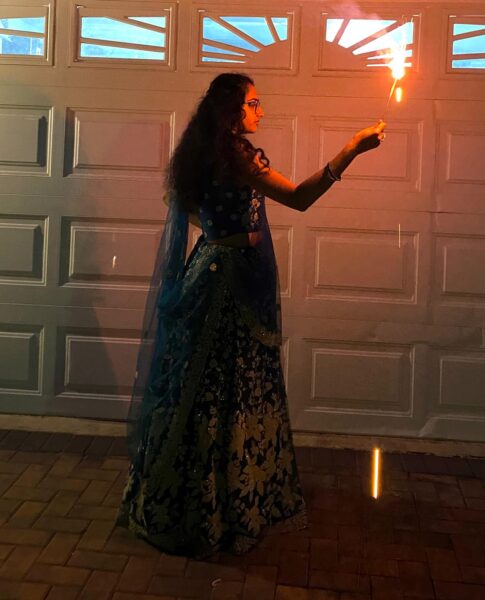
Every Diwali, it is customary to wear new ethnic clothes from a grand lehenga, which is a two piece skirt and top, to colorful saris wrapped around the body, to a kurta, a simple top with a cut on the sides paired with pants for men or leggings for women. You can never go wrong with accessorizing with long, dangly earrings, jhumkas, rows of colorful bangles, and a long necklace with an intricate pendant. To top it all off, a bindi-a red dot worn on one’s forehead for decorative purposes-adds the perfect finishing touch. You can also wear a payal, an anklet, making sounds like chimes as you walk past the laughter and glimmers of light.
The Food
The smells of home-cooked meals such as rasam (soup), steamed beans, lentils, and curries is what bring everyone together sitting at the table. People concentrated on the food, with their mouths too full to even speak to each other. Sweets are what make people’s mouths water, from ladoos to kaju katli to gulab jamun.
Inclusivity
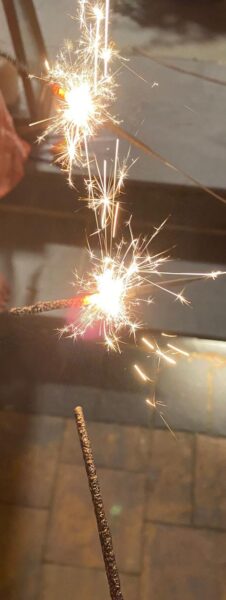
Diwali has become an inclusive holiday, with many people from different backgrounds celebrating it. Editor and Chief of Teen Vogue, Versha Sharma wrote it best in her article, “Vice President Kamala Harris Hosts Historic Diwali Celebration at Her Home,” saying that “now, there we were, a community supporting one another, celebrating our successes. Most important, we were celebrating our heritage, passing an ignited flame from sparkler to sparkler, in one of the most hallowed spaces in the nation’s capital. Community and solidarity are how we move forward. It’s how we find light in the dark.” These words truly encompass the meaning of Diwali. When lighting sparklers, it is a moment that is shared with friends and family. Quite literally, when one person gets a sparkler lit, they share it with a friend or family member to get theirs lit, bringing the sparklers close together.
View this post on Instagram
Actress Lilly Singh hosted her annual Diwali party this year, filled with love, light, and laughter. Guests included Chappel Roan, Lara Raj, Victoria Justice, Ruby Rose, Hayley Kiyoko, Ashley Park, Poorna Jagannathan, Richa Moorjani, and many more. In New York, Anjula Acharia hosted her annual ‘All That Glitters Diwali Ball’, bringing family and friends together from diverse backgrounds, including Falguni Peacock, Bozoma Saint John, Priyanka Chopra Jonas, Nick Jonas, Avantika Vandanapu, and many more. These two events highlight that though Diwali may be a Hindu festival, it is a celebration for all. Even Disney World joined in the celebration, with Mickey Mouse wearing a sherwani and Minnie Mouse wearing a sari.
View this post on Instagram
The Impact
Diwali has created a large impact, bringing people together. As a South Indian, I am always pleased to see Diwali written on my calendar app. From New York to Los Angeles, states have recently started to recognize Diwali as a holiday, with school closures during the festival in respect for those who celebrate it.
View this post on Instagram
My Experience
For me, Diwali has always been a festival I celebrate with my family. From wearing new clothes that we bought in India previously, with the strong smell of kumkum, a red-orange powder, emanating from the garments, marking them as new clothes ready to be worn. To putting up Christmas lights outside and light wax candles at every corner of the house. To the plethora of foods and sweets that my grandmother makes. Though my favorite part is lighting sparklers with my cousins, passing on the light to each other, finishing the boxes of sparklers we have kept. Diwali brings people of all backgrounds together, and though we may be different in many ways, from the moment of wearing ethnic clothing adorned with jewelry to eating foods and sweets to lighting sparklers with one another, we are all united in the shared experience of celebrating our heritage. It is a way to keep spreading the light for many generations, always remembering the true meaning of Diwali.
Follow Style Cartel on TikTok and Instagram! And read more about Lifestyle & Culture here!
