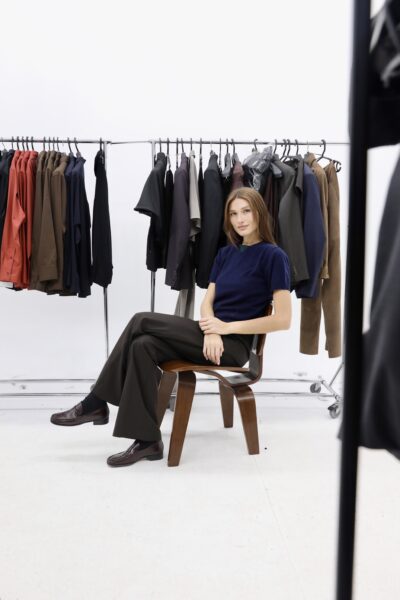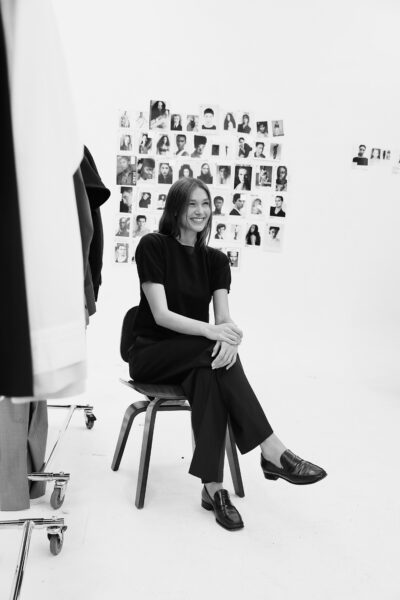





At a moment when fashion feels increasingly shaped by excess, accelerated trends and visual noise, Mondepars continues to move in the opposite direction — one defined by restraint, permanence and emotional precision.
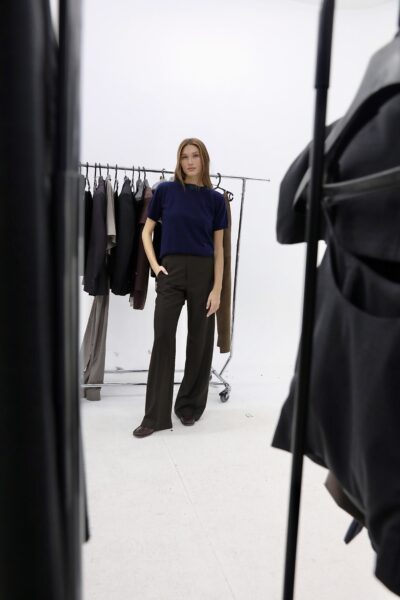
At the helm of the brand, Sasha Meneghel has built a universe grounded in tailoring, material integrity and personal truth. Yet within this new collection — to be presented this Wednesday — there is an even deeper emotional layer: Alda, her grandmother and one of the greatest creative influences of her life.
“Mondepars began with Alda,” Sasha tells us.
It was through her grandmother that she first discovered art, freedom of expression and creative instinct. A woman who transformed garments, created costumes, adapted pieces and found beauty even in difficult circumstances. A woman who, according to Sasha, never allowed life’s limitations to interrupt her creativity.
“She used the tremors in her hands to create effects in her paintings.”
As Sasha revisited old letters, photographs, videos and family memories, the collection gradually took shape through the merging of Alda’s world and the already established codes of Mondepars. References move subtly between the convent where Alda once lived, the theatrical influence of her father — a circus performer — and the quiet resilience with which she faced Parkinson’s disease without abandoning her artistic practice.
The collection never attempts to turn memory into nostalgia. Instead, emotion is translated through construction, silhouette and permanence. Familiar Mondepars tailoring reappears with new proportions and reinterpretations, while transformation remains one of the house’s strongest codes.
“We like to look at pieces that already tell the story of Mondepars and transform them.”
That same idea of transformation existed within Alda long before concepts such as upcycling entered the contemporary fashion conversation. Clothing was continuously adapted between siblings, altered with embroidery, lace or small interventions so that each piece retained individuality and affection.
“She created so much with so little.”
Despite the emotional depth behind the collection, Mondepars remains remarkably aligned with its sophisticated and understated visual language — one far removed from obvious or caricatured interpretations of Brazilian fashion.
As Sasha recalls, quoting Brazilian designer Alexandre Herchcovitch: “What is made in Brazil is Brazilian.”
For Sasha, Brazil is too plural to exist within a single aesthetic definition. That plurality reveals itself not through cliché, but through versatility, texture, climate and functionality. Wool, for instance, becomes an important symbol within the collection — less associated with traditional winter dressing and more connected to adaptability, fluidity and longevity across seasons.
Perhaps the most moving part of our conversation, however, was hearing Sasha speak about recognising Alda beyond the role of grandmother.
“To look at her as inspiration beyond being my grandmother was fascinating for me as a woman, as a businesswoman and as a designer.”
By the end of our conversation, when we asked what she would say to her 18-year-old self at the beginning of this journey, her answer arrived without hesitation:
“Never stop studying. Fashion is an infinite school.”
Thank you, Sasha, for your time. Best of luck with the collection!
Captured & Curated by Lee Oliveira & Patrick Doering