
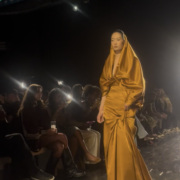





Picture this: you are casually scrolling through Instagram during Fashion Week, then you stumble upon a creation you designed back in 2019, strutting down the runway in 2024 under the spotlight of a renowned global luxury brand. This scenario was more than an imagination for renowned Senegalese Fashion Designer, Sarah Diouf, founder of Tongoro Studio whose designs have been seen on several celebrities like Beyonce, Naomi Campbell, Alicia Keys, Iman, Burna Boy and so on.
View this post on Instagram
Taking to Instagram, Sarah Diouf, Tongoro’s founder passionately shared her experience and didn’t hesitate to call out French luxury brand, Balmain, for culturally appropriating and copying her face jewellery design. She was inspired by the Woodabe tribe men’s makeup. However, a deeper investigation unveiled a fascinating twist – at least three other brands had released strikingly similar designs before both Tongoro and Balmain. This begs the question: Are ideas truly a dime a dozen? In an industry that thrives on drawing inspiration from the past, can we genuinely consider anything as original? The rest of this article unfolds against this intriguing backdrop.
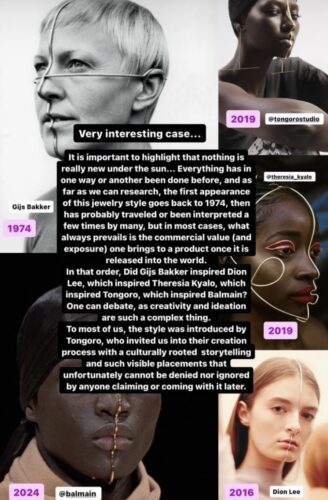
IMITATION OR INSPIRATION
Inspiration is a powerful force that propels one to create, innovate, and achieve remarkable things. It can be drawn from various sources such as people, nature, art, and literature. Without inspiration, many of the world’s greatest inventions, artworks, and scientific breakthroughs wouldn’t exist. However, navigating the realm of inspiration can be tricky. While it’s crucial for fostering creativity and innovation, there’s a delicate line between drawing inspiration from something and outrightly copying it. Understanding this difference is vital to ensure one’s creations are genuine and not mere imitations of someone else’s work.
When a person is inspired, they take an idea or concept and make it their own. They build upon it, infusing their unique perspective and creativity to craft something entirely new and original. On the contrary, mere copying involves replication without any significant original thought or innovation. This crosses into the realm of plagiarism and is generally disapproved of in the creative world.
SHOULD THOSE IN GLASS HOUSES THROW STONES?
Throughout the years, fashion designers have consistently drawn inspiration from bygone eras to craft their unique collections. The adage ‘there’s nothing new under the sun’ rings true, placing the emphasis on how designers infuse their originality and authenticity into interpretations of shared inspirations. After all, inspiration doesn’t exist in a vacuum. Fashion evolves and revolves. Because fashion is a perpetual cycle of innovation and reinterpretation, the line between influence and imitation becomes increasingly blurred. How far back in time is ‘too soon’ when it comes to revisiting and reimagining the past?
“Start copying what you love. Copy, copy, copy, copy. At the end of the copy, you will find yourself.” – Yohji Yamamoto
KNOCKOFFS: THE BANE THAT IS FAST FASHION
Although fast fashion promotes competition by offering market alternatives, creating trends, and providing affordable choices for consumers, it has proven to be unethical in production and even more so in its copying practices.
Giant fast fashion brands like Shein, Fashion Nova, H&M, and Zara, are known for quickly making replicas of designer garments, intended for a knowing audience. Unfortunately, this practice can disadvantage the original creators of these pieces.
Therefore, the average consumer needs more than education. They need a viable and affordable alternative to be able to permanently curb this phenomenon.
View this post on Instagram
“By the time a design of ours is copied in a cheaper dress line, it’s probably time for it to go.” – Leon Bendel Schmulen
THE IMPACT ON THE INDUSTRY
While larger brands with significantly larger budgets may not feel a substantial impact, the copying of small, independent fashion designers poses a unique and significant problem. Existing intellectual property laws or attempts at reform are yet to fully address this issue. Unlike the established brand, whose product is easily distinguishable from copied versions, an emerging designer‘s garment does not likely indicate a unique source, increasing its vulnerability. Emerging designers, who are still working to grow, feel the impact of this issue the most. When their designs are easily copied and sold at a much lower cost, it becomes challenging for them to grow and succeed.
To counter this, fashion designers are putting extra effort into creating more intricate designs and techniques, aiming to discourage copycats.
View this post on Instagram
THE POSSIBILITY OF LEGAL PROTECTION
There are a myriad of opinions as to whether fashion designs are worthy of intellectual property protection. Certain authors and scholars believe that the fact that the fashion industry thrives on trends makes copying necessary while others believe that copying in the fashion industry does more harm than good.
Navigating intellectual property law can be tricky and depends on where you are and your registration status.
Fashion designers can protect their intellectual property rights to different extents based on jurisdiction. Certain design elements or combination of elements, such as colour, symbols, or textile design, can qualify for protection through registration, even if some garments may not meet the criteria.
While you don’t necessarily need to register a design for protection, there are perks to doing so. A lack of protection brings several downsides. It results in brain drain, as innovative designers may move to countries with protective laws. Fashion designers are deprived of financial rewards for their creations. Imitation also hinders innovation, allowing mediocrity to thrive in the long run.
Evidently, a thin line exists between inspiration and imitation. Fast fashion’s rapid replication of designs raises questions about sustainability and ethics, impacting both emerging designers and established brands. While legal protection exists, its effectiveness varies based on jurisdiction and registration. As consumers, do we prioritise affordability over the potential drawbacks of copying? In the quest for innovation, how can we strike a balance between protecting creativity and authenticity, while fostering a fashion landscape that thrives on trends?
Stay updated on all things fashion, lifestyle, and culture. Follow us on Instagram @stylecartel and TikTok @stylecartelmedia. Don’t miss out – sign up for our newsletter to get early access to the latest drops in your inbox.
Stay tuned to StyleCartel for more Fashion content.
